
跳到主要內容區
Center for Institutional Research

畢業生永續學習成果之評估 Assessment of Sustainable Learning Outcomes

The Sustainable Development Agenda 2030, detailed in the United Nations Sustainable Development Agenda 2030, was formally adopted at the United Nations Sustainable Development Summit in September 2015. Replacing the Millennium Development Goals (MDGS) with the Sustainable Development Goals (SDGS) provides guidance for the global path to sustainable development beyond 2015. National Tsing Hua University also hopes that its graduates will learn the sustainability in their studies and regularly evaluate them to facilitate their sustainable operation and fulfill the university's purpose and mission to pursue the goals of top universities of excellence.
2015年9月聯合國(UN)可持續發展峰會正式通過了《2030年永續發展議程》,針對永續發展目標進行詳述。使永續發展目標取代了千禧年發展目標(MDGS),並為2015年後的全球永續發展道路提供了指導。清華大學也希望本校畢業學生能習得永續,並且能定期對學生進行評估,以利於永續運作,完成學校辦學宗旨與使命,以協助學校追求卓越頂尖大學的目標。

問卷設計與實施 | Methodology

The SDG Sustainable Graduating Students Learning Feedback Questionnaire was developed by the Center for Institutional Research in 2021. The concept of sustainable development is receiving increasing attention, and the Center for Institutional Research has drawn on the "Educational For Sustainable Development Goals-Learning Objectives" literature to design questionnaires that are consistent with the university's sustainability goals and learning outcomes. The graduate review survey, conducted by university students from June to October 2021, included not only the full number of graduates but also the degree to which students achieved sustainable learning outcomes during their college years.
SDG永續文化相關問卷由清華大學校務研究中心於2021年開發。2021年有感於永續發展的理念日益受到重視,本校校務研究中心參考《Educational For Sustainable Development Goals-Learning Objectives》文獻,設計出與本校永續發展目標與學習成果相符合之問卷題目。本研究對象為2021年6月至10月所畢業的大學部學生,進行畢業生進行學習回顧調查,這份畢業生問卷不僅含括本校全數畢業生,以探究學生在大學期間所具備的永續學習成果(Sustainability Learning Outcomes)之達成程度。
Survey Details (PDF)

永續學習成果評估結果 | Assessment Results

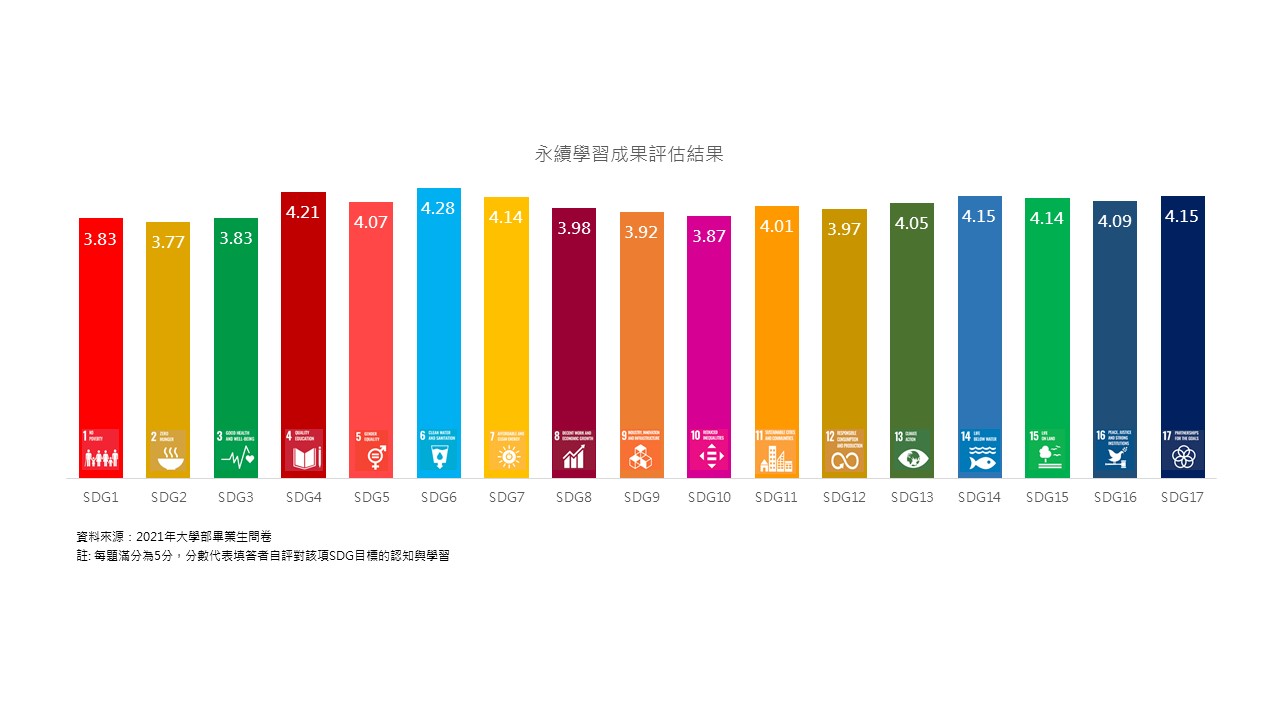
永續學習成果評估結果
圖:NTHU Graduate Sustainability Learning Statistics (1-5 Likert Scale)

The bar chart illustrates the sustainability learning outcomes of graduates from NTHU's core sustainability-related departments. Scores range from 1 to 5, with 5 representing the highest level of awareness and learning. Among the 17 SDGs, Goal 6 (Clean Water and Sanitation) received the highest average score. This reflects the severe water crisis Taiwan faced in the summer of 2021 (graduation season), which deeply resonated with the students. Goal 4 (Quality Education) also received high ratings, underscoring NTHU’s core mission of pedagogical innovation and indicating that graduates recognize quality education as a cornerstone of sustainable development. In contrast, lower scores for Goal 1 (No Poverty) and Goal 2 (Zero Hunger) reflect a specific demographic characteristic of our student body: as students of one of Taiwan’s top-tier universities, they often possess socio-economic advantages and better career prospects. Consequently, their firsthand awareness of poverty and hunger issues is relatively limited. This highlights a critical area where NTHU should enhance student engagement through future curriculum and extracurricular activities. Most other goals averaged around 4, demonstrating that NTHU graduates possess a robust and comprehensive understanding of the SDGs.

長條圖為本校清華大學部畢業自永續核心系所學生的永續學習成果,每個題項1到5分,5分為滿分,分數代表填答者對該項目標的認知與學習。17項SDGs以Goal 6的平均分數最高,呼應台灣於2021年夏季(畢業季節)發生的嚴重缺水危機,讓畢業生們對此議題感同身受。同樣高評價的還有Goal 4,對課程的創新與投入是清華大學的核心教育理念,高評價也顯示畢業生認知到良好的教育對社會永續發展至為關鍵。 Goal 1與Goal 2的分數偏低則反映了本校學生的共同特點:身為台灣的最佳大學之一,能夠錄取與畢業的學生具有社會階級的優勢、並具有工作機會的優勢,對貧窮與飢餓議題的認知與瞭解相對不足,本校未來應從課程與活動中加強學生的學習動機。其餘Goal的分數大致在4分上下,顯示本校畢業生對於SDGs皆具有充分程度的瞭解。
瀏覽數:
登入成功